Figuring out where everything fits
As you go along through this whole parenting, figuring out who you are, figuring out where everything fits journey, I've come to a point where I know what I want. I know how to get there. I'm starting to figure out the people I have in my corner.
And parenting them all the way along has been weird. There are things you have to show up for that you never thought you'd have to show up for.
The parent they understand
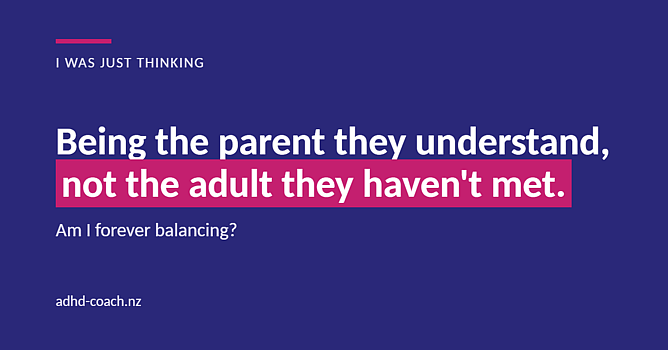
I'm trying to find the balance between the parent they understand and the adult they haven't met. And I'm finding that a really, really fine balance.
But the process is making me really annoyed. They don't quite get who I am and the accommodations I need. It takes a long time to express, and they need a lot of scaffolding.
Am I alone in this?
Are you forever balancing between being a parent and being an adult? Between adult and mum, adult and dad? Do people think like this? Am I alone thinking this?
From the research, I'm not alone, but my exact question hasn't really been asked yet.
Parental burnout is a recognised condition. Roskam, Mikolajczak and colleagues describe exhaustion in the parenting role, feeling fed up with it, and a contrast with who you used to be as a parent.
Researchers call the pull between closeness and conflict with your children intergenerational ambivalence (Pillemer and Lüscher). They still don't know whether it lasts a whole lifetime or only shows up at certain stages.
And there's very little research on how neurodivergent identity forms within families, including ND parents with ND kids (Lilley and colleagues, 2022). So a late-identified parent wanting her kids to meet who she is now is mostly uncharted.
So where do we go from here?
So how do we figure out how to be a "successful" parent? How do we even feel like we're "successful"? Everyone's understanding of success looks different. They're coming to me about all of this stuff. Do I see that as "success" in a very different way than most people might view success?
We have a script in our heads about how we understand our children at different stages of their lives, and from different stages of our own.
Hold the to and fro.
Autonomy of self versus helping them establish autonomy of self.
It's a really big to and fro, and I'm still finding that balance.
Hold your tone.
From my experience, we can't establish our own autonomy around a contentious issue without thinking about our facial expressions and social cues.
With a neurodivergent person, especially a late teen or early adult, we as parents still have to think about how our non-verbal communication comes across, so they don't get the wrong sense of what we're trying to say.
I'm frustrated and annoyed that it takes a long time to express things and that they need a lot of scaffolding. That frustration also needs to make room for understanding how they respond to social cues.
When we're talking about something really strong, important and impactful, our non-verbal communication is just as valid as our words.
Understand the structure first.
What I talk to clients about: understand the structure behind something before trying to manage the actual issue.
Where's the anger coming from? Where's the frustration coming from?
Is it a push and pull of my identity and autonomy versus their identity and autonomy?
Acknowledge the anger, the aggravation and the annoyance around that.
Ask them back.
Scope it as a question back to our children, our adult children.
How is it for them?
What angers them? What frustrates them in these conversations, and about holding autonomy?
Finding my people
If this sounds like you, check out the resources on my website, and join my newsletter for more in my "I was just thinking" series.
Have your kids met the adult you've become yet?
References
Lilley, R., et al. (2022). "Peas in a pod": Oral history reflections on autistic identity in family and community by late-diagnosed adults. Journal of Autism and Developmental Disorders. (Check volume and pages before posting.)
Mikolajczak, M., Aunola, K., Sorkkila, M., & Roskam, I. (2023). 15 years of parental burnout research: Systematic review and agenda. Current Directions in Psychological Science, 32(4), 276–283.
Pillemer, K., & Lüscher, K. (Eds.). (2003). Intergenerational ambivalences: New perspectives on parent-child relations in later life. Emerald Group Publishing.
Roskam, I., Brianda, M.-E., & Mikolajczak, M. (2018). A step forward in the conceptualization and measurement of parental burnout: The Parental Burnout Assessment (PBA). Frontiers in Psychology, 9, 758.